Article · October 2021
Many world-class medical researchers are locked into an outdated presentation paradigm. A different approach leads to more useful and effective medical presentations — illustrated with one real-life case. By Edouard Gruwez.
Having followed the ESC Congress (European Society of Cardiology) twice: the quality of the research presented by world-leading physicians is without doubt sublime, and the ESC invested heavily in the look and feel of the slides and the digital experience. But the way the research is presented is totally inefficient in today's world of information overload.
Let's be honest: not a single participant can remain attentive throughout a presentation in which interesting conclusions are implicit, or hidden underneath mountains of less relevant data. Most physicians I discussed this with claim the standardised structure of medical papers is the only way to interpret research correctly. But is that so? That structure dates from before the digital revolution, when information and attention detractors were a fraction of what exists today — and it presents from the researcher's perspective rather than the practitioner's.
Seven cardiologists and endocrinologists created a presentation for physicians on the accuracy of photoplethysmography (PPG) interpretation to predict atrial fibrillation (AF). They used the TLSM approach — and called the outcome "brilliant and spot on".
For non-physicians: PPG is the technology that lets a smartphone camera measure your heartbeat by interpreting colour variations in your fingers. Apps use it to detect heart-rhythm disorders; early detection saves lives, at home, with no equipment beyond a smartphone — provided the measurements are interpreted correctly. The underlying study was published in Frontiers in Cardiovascular Medicine.
The objective of a medical congress isn't ego-stroking: it is for healthcare professionals to improve their practice and patient outcomes — and secondarily, for researchers to be inspired, for policymakers to improve health economics, for industry to direct investment. Each audience benefits when the conclusions are translated to their reality by the researcher, instead of leaving each listener to do that translation alone. In our PPG case, the question most cardiologists have is: should our team consider using PPG to screen for AF?
The traditional structure — hypothesis and aims, methods, results, discussion, conclusion — is useful for assessing the quality of research. But it is not optimal for someone who wants to use the research: you lose the audience long before the conclusion, and interesting sub-conclusions get lost. TLSM structures the same content as: framing (what was known, what is the issue — noting that the audience's issue is not necessarily the research question), then the conclusion, then the discussion with data, examples and recommendations.
Start with the key conclusion and add detail in a question-and-answer dialogue, using the questions your audience would ask. For the case at hand:
Should we consider using PPG for AF screening? Yes — especially for higher-risk patients, with some considerations.
Why? Sensitivity is as good as a single- or 12-lead ECG; we will detect more AF early that we would miss today — it needs no investment beyond a smartphone, patients can measure at the moment they feel an abnormality, and it requires no specific training for the cardiologist.
What considerations? A positive PPG should be followed by an ECG (the 12-lead ECG remains the guideline standard, and PPG gives relatively many false positives). For low-risk patients the false-positive rate is high today — with upward potential once AI interpretation is added. PPG must be interpreted by a cardiologist using the tachogram and Poincaré plot. And the study — 57 cardiologists, 30 patients — deserves validation at larger scale.
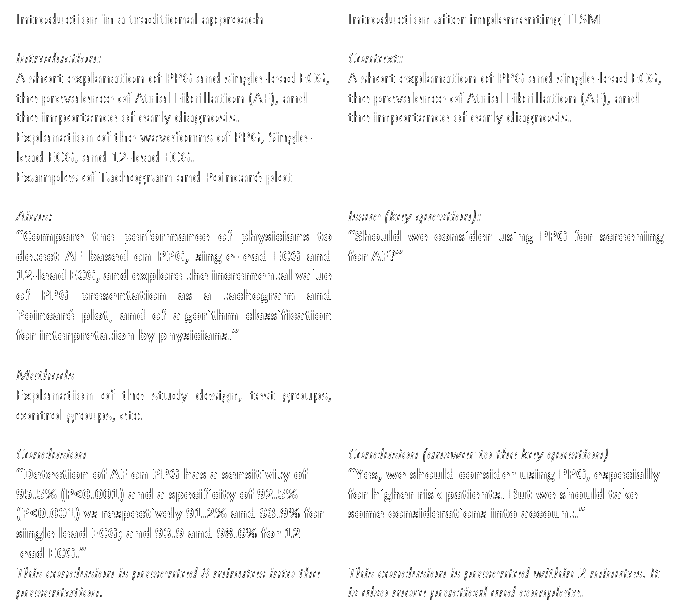
The practical essence of the study, summarised in less than three minutes. The methods were left out entirely — mentioned only where they lead to a conclusion worth mentioning.
The pyramid gives the mind the cognitive essence in minimal time. But humans also need details that speak to intuition — what I call story handles — to keep attention, integrate and memorise: the relevant graphs at the right point in the pyramid, a concrete patient case whose life was saved, a picture of the device and a real PPG output, metaphors, quotes, humour. The craft is finding the right balance between scientific solidity and attention.
Complex professional language does not create an aura of professionalism — most cardiologists will not immediately parse "photoplethysmography" either. You cannot avoid professional terminology, but don't overestimate your audience: no more than 3–4 terms people don't use in everyday life, and split long written sentences into short spoken ones. The scientific precision stays; the cognitive load drops.
Definitely not. TLSM is a thinking framework, not a rigid structure. For reviewers who must judge the quality of claims, the traditional structure remains useful. And yes — this approach invites the presenter to go beyond the strict interpretation of the study and say what the audience should do with it. My answer to that criticism: isn't that exactly the value the presenter adds? If not, why not just send the paper as a PDF?